


Group Classes vs Private Training for Dogs
- Caryn Self Sullivan, PhD

- 2 hours ago
- 6 min read
A puppy who cannot settle after seeing another dog, a retriever who pulls hard toward every interesting smell, and a dog who guards the couch are not starting from the same place. That is why the choice between group classes vs private training is about much more than convenience or price. The best setting is the one that lets your dog learn safely, lets you practice effectively, and addresses the behavior affecting your real life.
Group classes can be enjoyable and useful. Private training can be transformative. Neither format is automatically better for every dog, family, or goal. The right answer depends on what your dog is doing now, what you need help with, and how much support you need to carry new skills from a lesson into daily routines.
Group Classes vs Private Training: The Core Difference
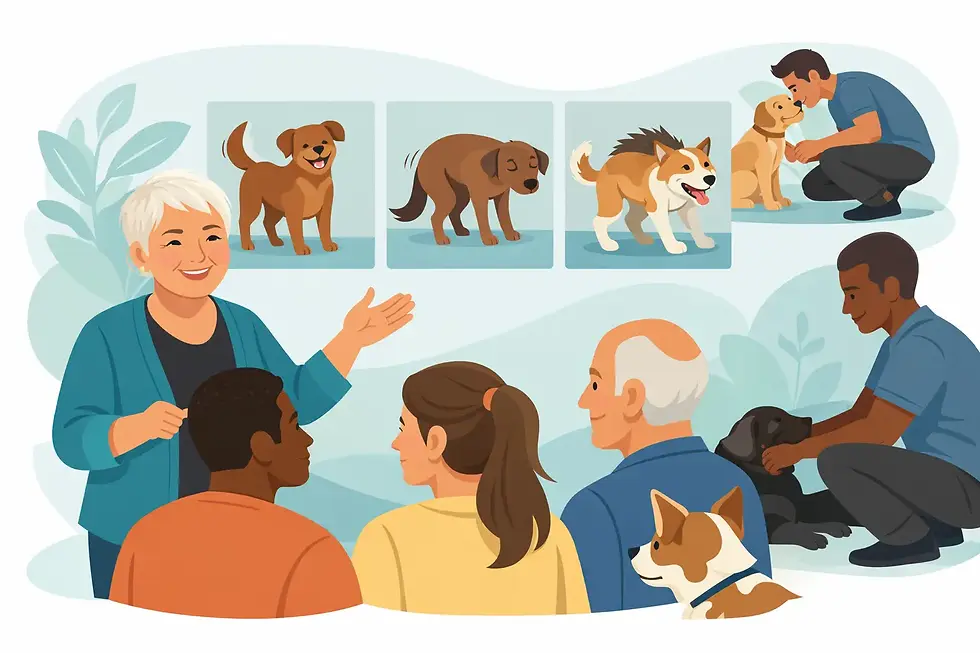
A group class teaches several dog-and-handler teams at once, usually in a structured setting with planned exercises. Participants may work on cues such as sit, down, stay, recall, polite greetings, and loose-leash walking. The presence of other dogs and people can offer valuable practice for dogs who are ready for that environment.
Private training is built around one dog, one household, and one set of circumstances. A session may happen in your home, at a veterinary office, on a neighborhood walk, in a park, or virtually, depending on the concern. Instead of working through a preset class curriculum, the plan begins with what is happening for your dog: the doorbell chaos, the barking at the front window, the panic when you pick up your keys, or the tense moments around food bowls.
That difference matters because dogs do not behave the same way everywhere. A dog may perform a lovely sit in a training building yet lose all ability to think when a skateboard passes the driveway. Training needs to account for the environment where the behavior happens.
When Group Classes Can Be a Good Fit
For a social, generally comfortable dog with foundation-level training needs, a well-run group class can provide helpful structure. New puppy owners may appreciate a regular time to practice handling, attention, basic cues, and calm exposure to new sights and sounds. Owners also benefit from seeing that other people are working through similar challenges.
The group setting can be especially useful when the dog can remain under threshold around other dogs and people. “Under threshold” means the dog is still able to notice what is around them while taking treats, responding to their person, and learning. A little excitement is normal. A dog who is barking, lunging, freezing, trembling, refusing food, or trying desperately to escape is not in a good learning state.
A quality class should not expect every dog to interact with every other dog. Puppy socialization is not a puppy free-for-all, and adult dogs do not need to greet unfamiliar dogs to be well socialized. Thoughtful classes give dogs space, teach handlers how to read body language, and respect each dog's comfort level.
Group instruction may also make sense if your primary goal is practice around mild distractions. For example, a dog who knows basic cues at home but needs to learn to focus politely near people and dogs may benefit from a carefully managed class after the foundation skills are in place.
Where Group Classes Have Limits
A group class has to serve the whole room. Even an excellent instructor cannot spend an entire hour focused on one family's morning routine, household dynamics, or the specific moment when their dog begins to guard an item. Class time is also limited. If your dog needs frequent breaks, more distance from other dogs, or a slower pace, it can be hard to get enough individualized coaching.
Some concerns are simply not appropriate to address in a typical group setting. Fear, anxiety, separation anxiety, reactivity, resource guarding, aggression, bite history, and serious conflict between household pets require careful assessment and a plan tailored to the dog and the people involved. Putting a worried or reactive dog into close proximity with triggers can make the problem worse, not better.
This is not a failure on the dog's part. It is information. The dog is communicating that the environment is too difficult right now. Good behavior work does not force a dog to “get used to it” through repeated overwhelming exposure. It changes the setup, teaches skills, and works at a pace where the dog can actually learn.
What Private Training Makes Possible
Private training begins with listening. Before deciding which cues to teach, a behavior professional needs to understand the full picture: when the behavior started, what tends to trigger it, what happens immediately before and after, how the household responds, and whether pain, health changes, or medication could be involved.
That assessment leads to practical recommendations that fit the home. If your dog jumps on visitors, the work may include the approach to the front door, the placement of a leash or gate, what guests should do, and a realistic plan for busy days. If leash walking is the issue, coaching can happen on the sidewalk where the pulling occurs, rather than only in a quiet indoor room.
Private sessions also make it easier to teach the human side of training. Timing, leash handling, treat delivery, body position, and reading early signs of stress can be adjusted in the moment. You are not left trying to adapt a general demonstration to a completely different dog once you get home.
For behavior concerns, privacy can be a relief. Many owners feel embarrassed or discouraged when their dog barks at visitors, growls over a chew, or cannot be left alone. These are not issues that need judgment. They need a thoughtful plan that protects safety, reduces stress, and gives everyone clear next steps.
Real-World Practice Is Not an Extra
Dogs are excellent at learning context. Unfortunately, that means a behavior learned in one location may not automatically appear somewhere else. A dog who waits politely at the kitchen door may still rush the front door when a delivery arrives. A dog who walks nicely in the backyard may pull toward another dog on a trail.
Private coaching can bring training to the places that matter most. For Northern Virginia and Northern Neck families, that may mean practicing a calm departure routine in the living room, walking through a neighborhood, or working on public manners in an appropriate dog-friendly space. The goal is not to make training look perfect during an appointment. The goal is to make daily life more manageable after the appointment ends.
Virtual training can also be highly effective for concerns that happen at home, particularly separation anxiety. A dog cannot practice being comfortable alone in a class full of people and dogs. Video sessions allow the plan to focus on departures, absences, camera observations, and the details of the dog's actual routine.
Cost, Commitment, and Value
Group classes often cost less per session than private training, which makes them an appealing entry point. They also offer a predictable schedule and built-in practice time. For a dog with straightforward training goals, that can be a sensible investment.
Private training generally costs more because the time, assessment, planning, and instruction are centered on your household. Yet a lower upfront cost is not always the better value if a class is too difficult for your dog or does not address the problem you need solved. Repeating programs that do not fit can be frustrating for both dog and owner.
Consider the cost of the behavior itself, too. Constant pulling can make walks unpleasant. Visitor-related jumping can make hosting stressful. Anxiety can affect a dog's welfare and a family's ability to leave home comfortably. Early, individualized support may prevent a manageable concern from becoming more entrenched.
A Simple Way to Choose
Ask yourself where the behavior happens and whether your dog can learn around unfamiliar dogs and people. If you want foundation practice and your dog is comfortable, social, and able to focus in a group environment, a well-managed class may be a good match.
If the behavior involves distress, safety concerns, strong reactions, household conflict, or a challenge that appears in a specific place, private training is usually the more appropriate starting point. The same is true if you want hands-on help applying training to your routines rather than following a general syllabus.
Sometimes the best path uses both formats. A dog may begin with private work to build confidence and essential skills, then join a suitable group class later for carefully selected distraction practice. The order matters. Success in a group should be built on readiness, not hoped for as a cure.
Your dog does not need to fit someone else's training timeline. Start with the setting where your dog can feel safe enough to learn, and where you can get the guidance to make each ordinary day a little calmer, clearer, and easier.


Comments