


Private Dog Training at Home That Fits Real Life
- Caryn Self Sullivan, PhD

- 2 days ago
- 5 min read
Your dog may sit beautifully in the kitchen, then pull hard the second you step onto the sidewalk. She may welcome visitors at first, then bark when they stand up. Or perhaps your puppy understands a cue during a quiet afternoon but forgets it when the children come home from school. These are exactly the situations where private dog training at home can make a meaningful difference: the training happens where your dog’s real habits, triggers, and routines actually exist.
A dog is not being difficult simply because a group class skill does not carry over to daily life. Dogs learn through repetition, context, and consequences. A behavior that looks reliable in a training facility may need to be taught again in the front hallway, near the food bowl, around the family cat, or at the end of a leash. Private coaching gives you and your dog the space to work on those details with a plan built for your household.
Why Home Is Often the Best Classroom
At home, a trainer can see the full picture rather than a single snapshot. That includes the layout of your rooms, where your dog rests, how visitors enter, when meals happen, who walks the dog, and what tends to occur right before a problem starts. Those observations matter. A dog who guards the sofa may be responding to crowding, unpredictable handling, pain, or a history of being repeatedly moved. A dog who explodes at the window may be rehearsing that response dozens of times a day.
This is not about blaming an owner or labeling a dog. It is about identifying patterns clearly enough to change them. Sometimes the right answer is a new training exercise. Sometimes it is management, such as changing access to a window, using a gate during busy times, or giving a puppy a better rest routine. Most often, lasting progress comes from combining both.
Home sessions also make it easier for every person involved to participate. A dog who listens to one adult but ignores everyone else has not necessarily learned the skill in a way that transfers. Families can practice consistent cues, handling, rewards, and boundaries together. That shared understanding is especially helpful when a dog’s behavior affects children, guests, caregivers, or other pets.
What Private Dog Training at Home Can Address
Private training is useful for common manners concerns and for more complicated behavior cases. A young puppy may need help with house training, chewing, biting, polite greetings, crate comfort, early socialization, and learning how to settle. An adolescent dog may need to work on jumping, recall, impulse control, or leash skills before those habits become deeply established.
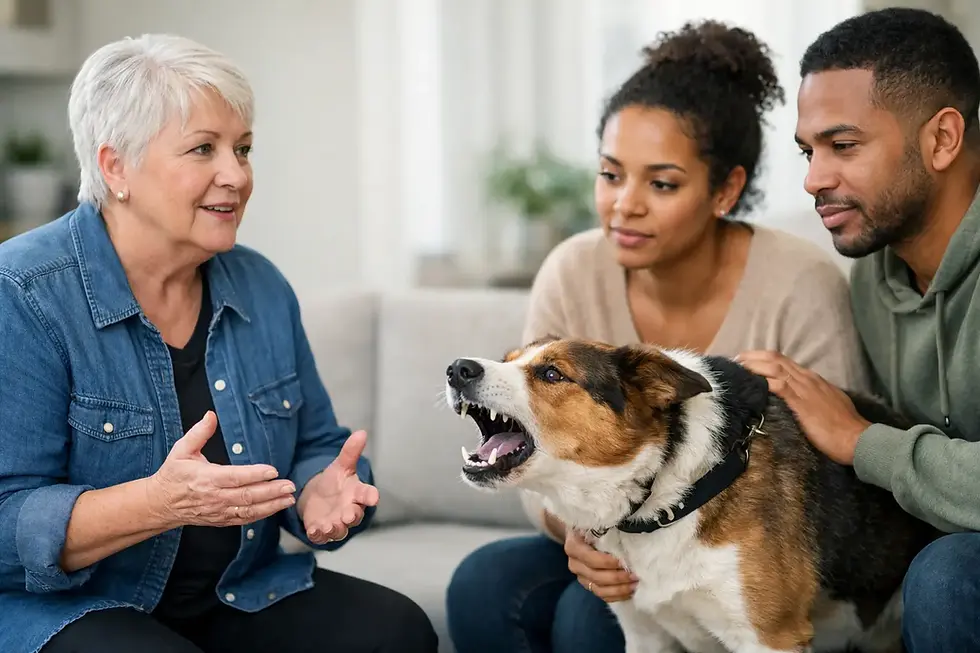
For adult dogs, the need is often more specific. Perhaps walks have become stressful because of barking and lunging at other dogs. Maybe your dog panics when left alone, guards food or toys, or is fearful around unfamiliar people. These concerns deserve more than a quick correction or a collection of internet tips. The behavior has a history, and the plan should account for that history.
Aggression, serious resource guarding, biting, and court-related cases call for careful assessment and a safety-first approach. The goal is not to force a dog to tolerate more than they can handle. It is to reduce risk, understand the triggers, build safer routines, and teach practical skills that support behavior change. In some cases, collaboration with your veterinarian is part of the process, particularly when pain, medical conditions, or medication may be affecting behavior.
A Good Plan Starts With the Right Questions
Effective private training should not begin with a one-size-fits-all list of commands. It starts by asking what you want daily life to look like. “I want my dog to be good” is understandable, but it is too broad to guide training. A more useful goal might be: “I want to answer the door without my dog charging past me,” or “I want to walk by another dog across the street without being pulled off balance.”
A qualified trainer will also ask what has already been tried, when the issue began, how often it happens, and whether there are warning signs before the behavior escalates. Video can be helpful when a behavior is hard to reproduce safely during a session, such as separation distress or reactions at the front window.
From there, the plan should be realistic. If your dog reacts strongly to dogs on narrow neighborhood sidewalks, the first exercise may not be walking directly past another dog. It may be teaching attention and movement skills at a comfortable distance, then gradually working in more challenging locations. If your puppy mouths during evening play, the plan may include sleep, enrichment, supervision, and appropriate play choices, not just repeating “no bite.”
Training the Person Is Part of Training the Dog
Private coaching gives dog owners something a written handout cannot: feedback at the moment it is needed. Timing matters when rewarding a dog. So do leash handling, body position, tone of voice, and knowing when an exercise is too difficult. Small adjustments can make a substantial difference.
You should leave a session knowing what to practice, why you are practicing it, and what improvement looks like. Good homework is not overwhelming. It fits into normal life - a few repetitions before meals, a planned greeting routine when someone comes home, or a short walk focused on one skill rather than trying to solve everything at once.
Progress is rarely a straight line. A dog may do well for several days and struggle after a schedule change, a houseguest, illness, or a stressful outing. That does not mean training has failed. It means the plan may need to be adjusted to meet the dog where they are. Patience is not passive. It is the willingness to observe, make thoughtful changes, and keep practicing the skills that support success.
When Training Needs to Move Beyond the Living Room
Home is often the starting point, but it is not always the final setting. If your dog’s challenge occurs on walks, in a park, at the veterinary office, or near a busy trail, training should eventually include those environments when it is safe and appropriate. Dogs need help generalizing skills from one place to another.
That transition should be gradual. A dog learning to walk politely may begin in the driveway before practicing along a quiet street. A fearful dog may work at a distance from the trigger rather than being placed directly in the middle of it. The point is not to prove your dog can cope. The point is to build the skills and confidence that make coping more likely.
For families in the Greater Fredericksburg and Northern Neck areas, Ask Dr. Caryn provides personalized coaching in homes and real-world settings, with virtual consulting available for English-speaking dog owners farther away. The setting can be chosen based on the behavior you want to change, not based on a fixed class schedule.
How to Get More From Your Sessions
Before your first appointment, write down the situations that concern you most and what happens immediately before, during, and after them. Be honest about bites, growls, escapes, accidents, or times when you felt worried. Clear information helps create a safer and more useful plan.
Avoid making major changes just before the session unless safety requires it. Your trainer needs to understand your dog’s normal routine. If there is a bite risk, however, prioritize safety: prevent access to likely triggers, use barriers, and follow the guidance of your behavior professional and veterinarian.
During training, focus less on perfection and more on clarity. Your dog does not need to perform for an audience. They need consistent opportunities to make better choices, paired with support that makes those choices possible. The best plan is one your household can carry out on an ordinary Tuesday, not just on your most organized day.
Your dog’s behavior is part of daily life, which means help should be practical enough to live with. Start with the challenge in front of you, protect everyone’s safety, and give your dog a fair path toward the calmer, more connected life you want to share.

Comments